

Performance Marketing for
Nino by Vani Mehta, a designer kidswear label known for ethnic and western fusion wear for children aged 1–10, partnered with SAAA Consultant in February 2026 to turn a series of ad-hoc sale campaigns into a structured, scalable Meta Ads engine — growing monthly revenue 5x while multiplying ad investment responsibly.
₹3,87,754
Total Ad Spends
(5 Months)
₹12,91,084
Total Revenue
3.33x
Overall ROAS

Campaign Setup
- Type of campaign: Meta Ads (Facebook & Instagram)
- Bidding strategy: Website Purchase conversions
- Geographic targeting: Pan-India, with concentration in Tier 1 & Tier 2 cities with strong online kidswear demand
- Channel mix: Catalog Sales campaigns, Retargeting (RT) campaigns, Direct Message (DM) retargeting, and Collection-launch prospecting campaigns
- Engagement start: February 2026
Where Nino Started
Before SAAA came on board, Nino by Vani Mehta was running Meta Ads largely in-house — launching a new campaign around almost every sale or collection date, from festive pushes to one-off catalogue drops. Over roughly two and a half years (June 2023 – January 2026), the brand ran 37 campaigns and generated a respectable blended ROAS of 5.29x. But the pattern behind that number told a different story:
- Small, inconsistent budgets: average spend of just ₹9,400 a month, with many campaigns testing at ₹500–₹2,000 and never scaled
- Only 23 of 37 campaigns (62%) ever recorded a purchase — the rest were unstructured traffic or awareness tests
- No dedicated retargeting or catalog infrastructure to systematically recapture add-to-cart and warm visitors
- Campaigns launched reactively around individual sale dates rather than a repeatable, always-on structure tied to each collection (Dhaaga, Tulip, Daisy, Phool)
The result: a brand with real product-market fit and pockets of strong performance, but no engine capable of turning that into predictable, scalable growth.
Solution
SAAA rebuilt the account from the ground up around a repeatable, collection-led structure designed to scale spend without losing sight of profitability:
- Collection-first campaign architecture: every new drop (Dhaaga, Tulip, Daisy, Phool) got its own dedicated Sale/Catalogue campaign, so creative, budget, and audience learnings stayed clean and comparable
- Always-on catalog sales campaigns pulling from the full product feed to scale conversions systematically, rather than one-off manual sales
- A parallel retargeting (RT) layer running continuously alongside every prospecting push, dedicated to add-to-cart users, website visitors, and past purchasers
- DM retargeting and CBO campaign structures introduced to diversify how warm audiences were re-engaged, including birthday-return flows
- A consistent, near fortnightly campaign cadence replacing the sporadic, date-driven launches of the earlier approach
Optimization Strategy
- Collection-based segmentation: launched separate Sale and Catalogue campaigns per collection so winning creative and audiences could be identified and scaled quickly
- Budget scaling on proven winners: once the Dhaaga Catalogue campaign (launched 11 Feb 2026) proved profitable at scale, budget was scaled aggressively — growing it into a ₹1.7L+ anchor campaign, then replicating the same playbook for the Tulip collection
- Layered retargeting: dedicated RT campaigns ran in parallel with every sale push to recapture add-to-cart and site-visitor audiences before they dropped off
- Seasonal and festive alignment: creative and offers were mapped to key moments — summer collection launches, Raksha Bandhan, and birthday-return campaigns — to keep messaging timely and relevant to parents
- Continuous testing: new formats (Instagram follower campaigns, DM retargeting, CBO structures) were tested and folded into the always-on mix as they proved effective
- Performance monitoring and reallocation: spend was reviewed campaign-by-campaign and shifted toward the catalogue and collection formats consistently returning ROAS above 3x
Results
The shift wasn't about squeezing more efficiency out of a small budget — it was about proving the account could absorb significantly more spend while staying profitable, and building the infrastructure to do that safely.
What the numbers show
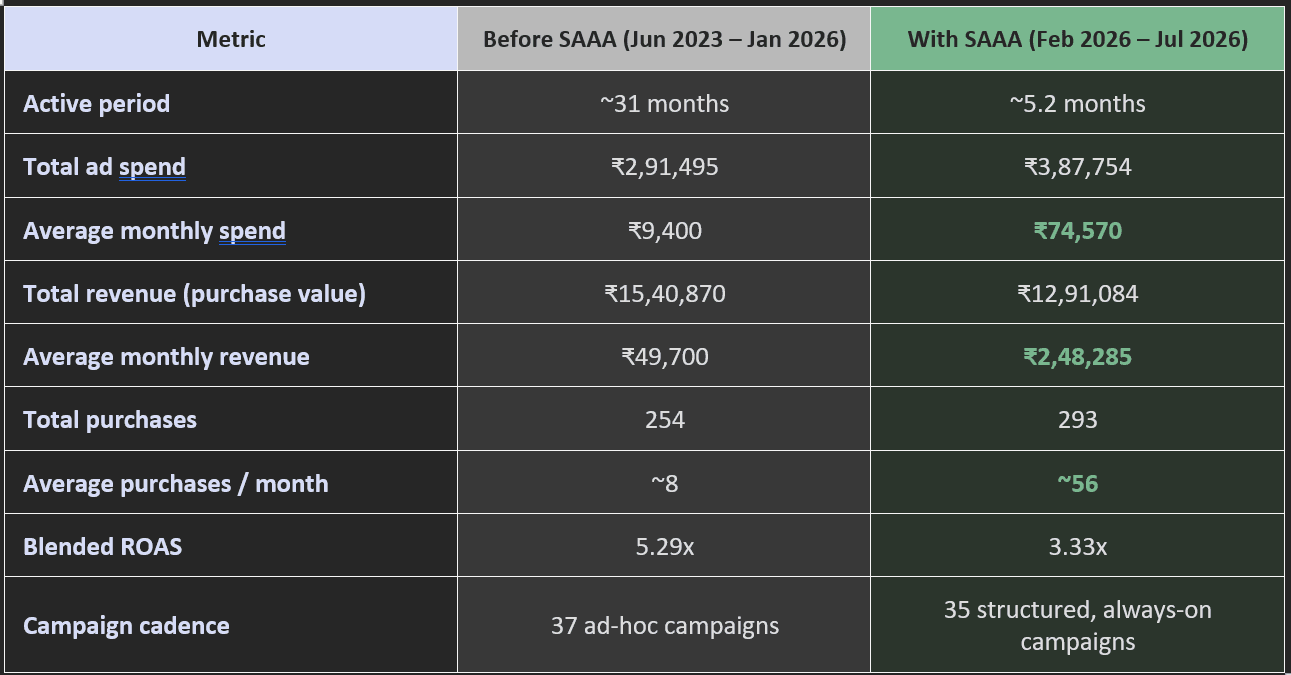
- Ad investment scaled ~8x on a monthly basis (₹9,400 → ₹74,570/month) without the account destabilizing Monthly revenue grew ~5x (₹49,700 → ₹2,48,285/month), and monthly purchase volume grew ~7x (~8 → ~56 orders/month)
- The account moved from 37 scattered, mostly-small campaigns over 31 months to a structured cadence of 35 purposeful campaigns in just over 5 months — a genuinely always-on engine
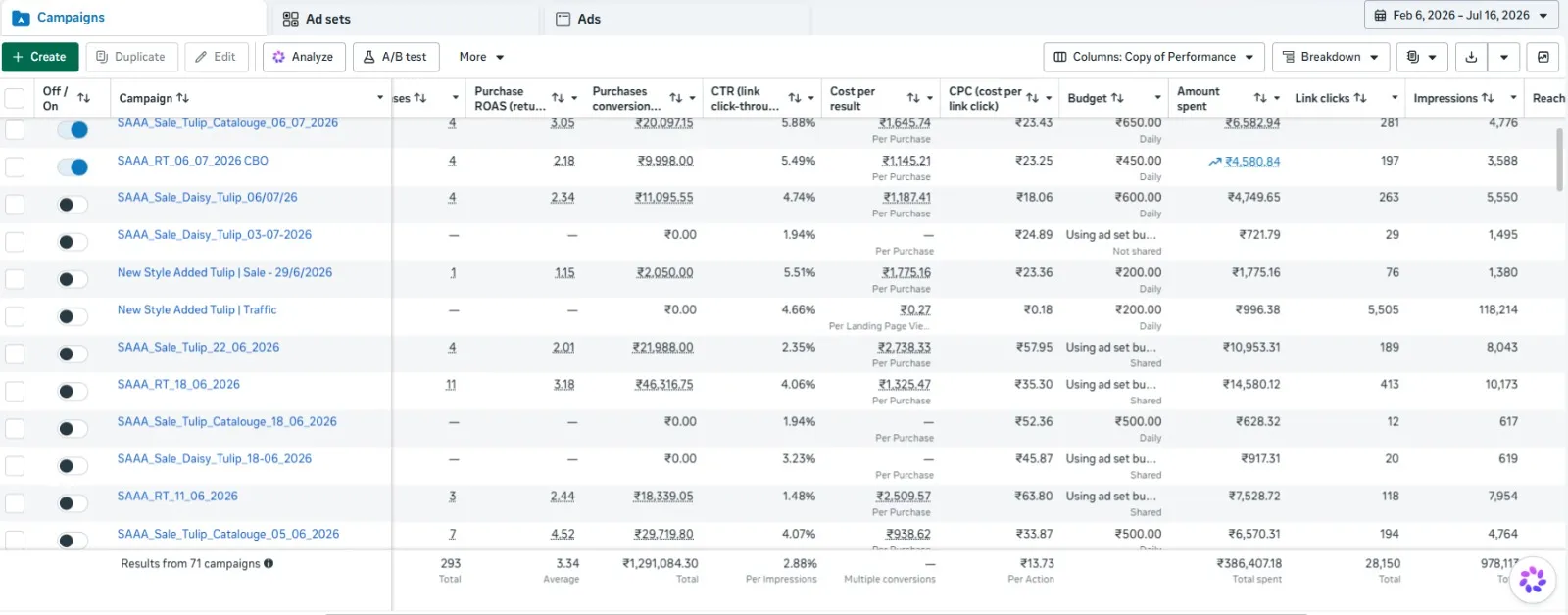
- Flagship campaigns proved the model at scale: the Dhaaga Catalogue campaign delivered 3.86x ROAS on ₹1.7L+ of spend, and the Tulip Catalogue sale hit 6.06x ROAS
- Blended ROAS settled at a healthy 3.33x — lower than the earlier small-scale average of 5.29x, but delivered on nearly 8x the monthly spend, which is the expected and accepted trade-off of scaling responsibly rather than staying small and “efficient” on paper
Conclusion
Nino by Vani Mehta didn't need a turnaround — it needed an engine. SAAA's collection-led campaign architecture, paired with a dedicated always-on retargeting layer and disciplined budget scaling on proven winners, took a brand running sporadic, manually-launched sales and turned it into a structured Meta Ads system capable of sustaining nearly 8x the monthly ad investment at a consistently profitable ROAS above 3x.
With every new collection now launching into a proven, repeatable framework — catalogue sale, parallel retargeting, and festive-moment creative — Nino is positioned to keep scaling predictably as new drops roll out through the rest of 2026.